Context & Objective
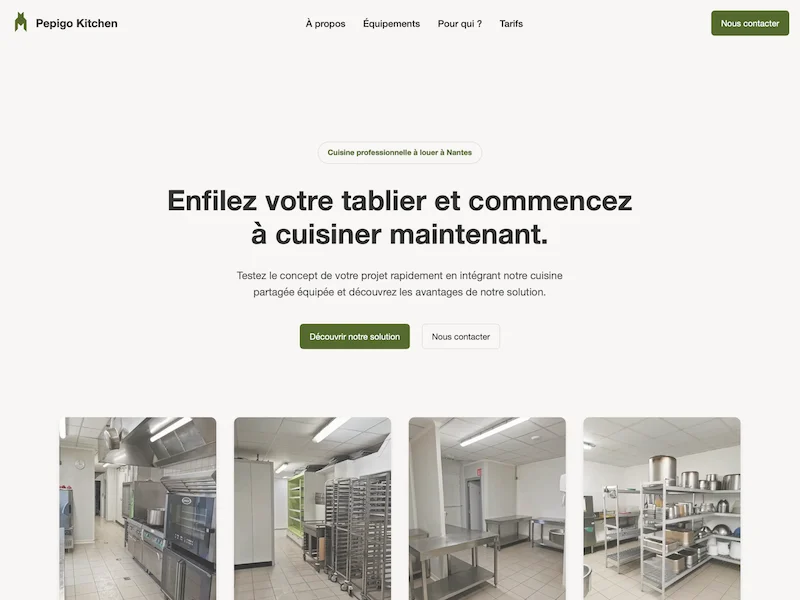
Pepigo Kitchen is a shared professional kitchen space in Nantes, available for food entrepreneurs, caterers, and artisans. The website was designed to present the space, its equipment, and pricing clearly — and to allow potential clients to get in touch directly.
This was the first project where I introduced Git and GitHub for version control, and where I deployed using Netlify — including Netlify Forms for handling contact submissions without a back-end.
What's in the project
The site is a single-page layout with multiple distinct sections, each addressing a specific part of the customer journey.
Multi-section layout
The page covers six sections: hero, about, equipment list, target audience (with eligibility indicators), pricing, FAQ, and contact — each with its own layout and visual treatment.
Accordion component
The FAQ section uses a custom JavaScript accordion — the first interactive component I built and modularised into a separate components/accordion.js file.
Contact form via Netlify Forms
The contact form handles submissions through Netlify Forms, with spam protection via a honeypot field and a dedicated success page after submission.
Inline SVG icons
All icons across the page — navigation, features, contact info — are inline SVGs, keeping them sharp at any resolution and avoiding additional HTTP requests.
Technical stack
Frontend
- HTML & CSS Semantic markup, custom stylesheet with dedicated files for layout, components and utilities
- Vanilla JavaScript Accordion component for the FAQ section, modularised into a dedicated file
Deploy & Forms
- Netlify Hosting with continuous deployment from GitHub, and Netlify Forms for contact handling without a back-end
- Git & GitHub First project using version control throughout the development process
Challenges & Learnings
First use of version control
Introducing Git on this project required adopting a new discipline: committing regularly, writing meaningful messages, and thinking in terms of incremental changes rather than saving a single file. The commit history reflects that learning process in practice.
Structuring CSS across multiple files
With a site this size, a single stylesheet becomes difficult to maintain. Splitting styles into dedicated files for layout, components, and utilities was a deliberate choice — one that introduced the question of how to organise CSS in a way that scales.
Building and modularising a JavaScript component
Writing the accordion component and extracting it into its own file was a first step toward thinking about code organisation beyond a single script. Understanding how type="module" works in the browser came directly from solving a real problem on this project.
Handling form submissions without a back-end
Using Netlify Forms meant understanding how a static site can process user input without server-side code — a useful introduction to the constraints and possibilities of static deployments.