Context & Objective
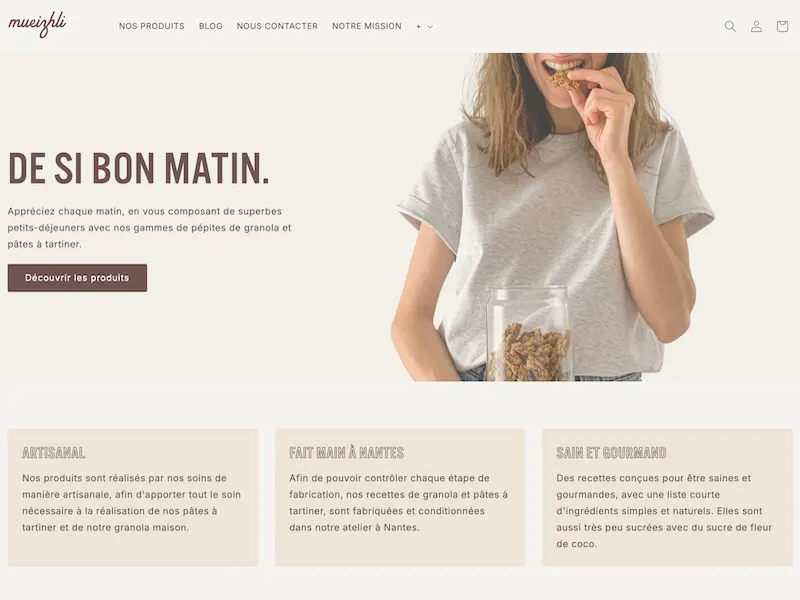
Mueizhli was an artisan food brand I founded under my company Edaj Kegin — selling organic granola and nut butters. This e-shop was built to handle online sales, showcase products, and help customers find retail partners near them.
This project holds a particular place in my path: it's where my interest in web development actually started. Back in 2019, putting this store online for the first time was the moment I realised I genuinely enjoyed building for the web — not just using it.
The site has since gone offline following the closure of the company, which I decided to close in order to transition into web development full-time.
Three iterations over the years
The Mueizhli website wasn't built once — it was rebuilt twice. Each version pushed me to learn more than the previous one.
WordPress + WooCommerce
The first iteration. I followed courses on WP-Marmite to get started, learned the basics of WordPress, and managed files through FTP with FileZilla. It gave me my first real contact with HTML, CSS, and how a CMS structures a project — though at the time I was mostly configuring rather than building.
PrestaShop
The second version pushed me further into CSS and HTML. PrestaShop's theming system is more complex than WordPress, which forced me to dig deeper — overriding styles, understanding how templates are structured, and solving problems that required reading actual code rather than clicking through a UI.
Shopify — final version
The final iteration landed on Shopify for its reliability and ecosystem. I customised a base theme extensively — adding custom HTML sections when the native ones didn't match the brand's needs, writing CSS on top of the theme, building a pop-up, and integrating a retailer locator map powered by a paid Shopify module connected to Mapbox.
Technical stack
Platform
- Shopify Base theme modified and extended with custom sections, layout overrides and brand-specific styling
- Liquid Shopify's templating language — used to understand and extend existing theme logic
Customisation
- HTML & CSS Custom sections, pop-up and style overrides written directly on top of the theme
- Mapbox Retailer locator map integrated via a paid Shopify module, displaying partner points of sale
Challenges & Learnings
Working within a platform's constraints
Shopify gives you a structured environment — which is efficient but limiting. Understanding where the theme ends and where custom code begins, how to override styles without breaking native behaviour, and how Liquid templates fit together was a practical lesson in reading and modifying code you didn't write.
Building for a real brand
Because Mueizhli was my own brand, every design and development decision had a direct business consequence. Getting the product pages right, making checkout smooth, ensuring the retailer map was accurate — these weren't abstract exercises. That pressure to ship something that actually worked was a better teacher than any tutorial.
Iterating rather than starting over
Moving from WordPress to PrestaShop to Shopify wasn't a sign of failure — it was learning through comparison. Each platform had different constraints, different templating logic, different ways of thinking about structure. By the third iteration I had enough context to make deliberate choices rather than just following tutorials.